
Measuring for blinds can feel confusing, especially for an inside mount. You want your new blinds to fit perfectly, look clean, and function smoothly. One wrong measurement and your blinds might not fit, leaving gaps that let in light or reduce privacy. But with the right steps and tips, you can measure like a pro—even if you’ve never done it before. This guide will walk you through everything you need to know about measuring for inside mount blinds, from tools and preparation to handling tricky windows.
Why do inside mount measurements matter so much? Because inside mount blinds sit within your window frame. This creates a sleek, custom look. But it also means you have less room for error—blinds that are even a fraction too wide won’t fit. Get it right, though, and your room will look more finished, and your blinds will work as intended.
Let’s break down the whole process, share real examples, and reveal tips that beginners often miss. By the end, you’ll know exactly how to measure for inside mount blinds and avoid common mistakes.
What Is An Inside Mount Blind?
When buying blinds, you’ll see two main installation types: inside mount and outside mount. For inside mount, the blind fits inside your window frame, leaving the frame exposed. This is the most popular choice for a modern, built-in look.
There are some real benefits to inside mount blinds:
- Neat appearance: The blind sits flush with the window.
- Saves space: No parts stick out into the room.
- Highlights window trim: Great if you have decorative moldings.
But it also means you need precise measurements. Window frames are rarely perfectly square, and even small errors can cause problems with fit.
Tools You Need Before Measuring
Before you start, gather the right tools to ensure accuracy:
- Steel tape measure: Always use a steel tape, not a cloth one. Cloth tapes can stretch and give inaccurate readings.
- Paper and pen: You’ll need to write down each measurement as you go.
- Step stool or ladder: For tall or hard-to-reach windows.
- Smartphone or camera: Take photos if you want to remember which measurement goes with each window, especially if you’re measuring several.
- Flashlight: Sometimes frames are deep or have shadows that make it hard to see the edges.
Pro tip: Make sure your tape measure shows both inches and millimeters. Some blind suppliers require metric measurements, especially for custom orders.
Understanding Window Frame Depth
Not all windows are suitable for inside mount blinds. One crucial detail is the window frame depth. This is the distance from the window glass to the edge of the frame where the blinds will attach.
Most blinds require a minimum depth to fit properly. For example:
- Roller shades: Often need at least 1¾ inches.
- Wood blinds: May require 2¼ inches or more.
- Cellular shades: Usually need 1¼ to 1½ inches.
If your window frame isn’t deep enough, the blind may stick out or won’t mount securely.
How to measure frame depth:
- Place the tape measure against the glass.
- Measure out to the very edge of the window frame (not the trim).
- Record the depth at several points (top, middle, bottom), as it can vary.
If your depth is less than the minimum required, consider outside mount blinds instead.
Step-by-step: Measuring For Inside Mount Blinds
Getting the right measurement means more than just checking the width. You need to measure width, height, and sometimes depth at multiple points.
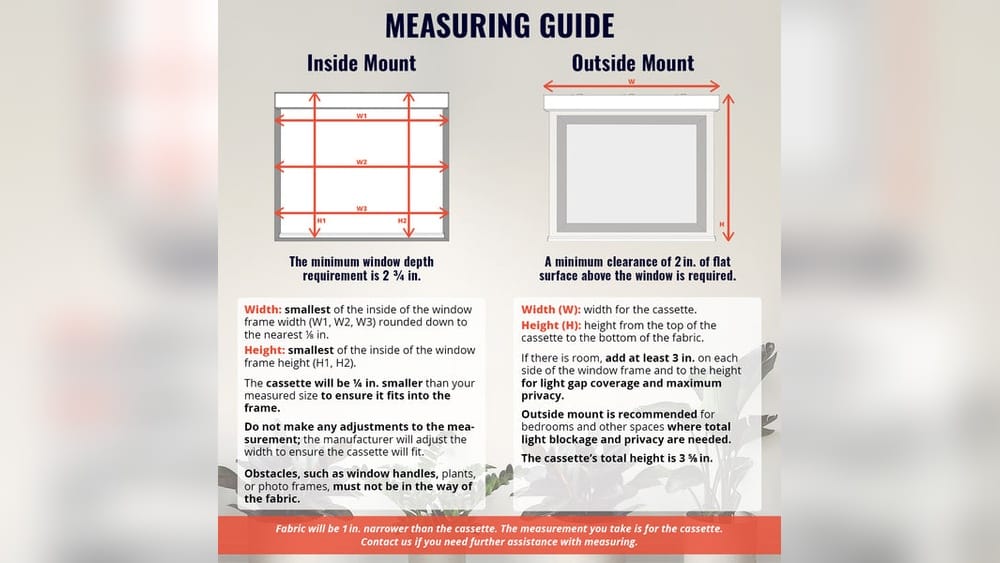
1. Measure The Inside Width
- Hold the tape measure inside the window frame, at the very top.
- Measure the width from one side of the frame to the other. Write this number down.
- Repeat at the middle and bottom of the window. Windows are often slightly out of square.
- Record all three numbers.
Important: Always use the narrowest width. This ensures the blind will fit at every point.
Example:
- Top: 35 ⅛ inches
- Middle: 35 inches
- Bottom: 34 ⅞ inches
Order your blinds at 34 ⅞ inches wide.
2. Measure The Inside Height
- Place your tape at the top inside edge of the frame.
- Measure straight down to the inside edge of the sill (the bottom).
- Take this measurement at the left, center, and right sides.
- Write down all three numbers.
Use the longest height. This ensures the blind will reach the sill, even if the window isn’t perfectly even.
Example:
- Left: 60 inches
- Center: 59 ⅞ inches
- Right: 60 ¼ inches
Order your blinds at 60 ¼ inches high.
3. Check For Obstacles
Look for any obstructions inside the window frame. Common issues include:
- Cranks or handles: These can block the blind from lowering fully.
- Security sensors: Sometimes installed for alarms.
- Tiling or deep trim: May reduce usable space.
If you find any obstacles, measure the space between them and make sure your blind style will fit.
Table: Quick Reference For Blind Types And Minimum Depth
Here’s a quick guide to minimum depth required for the most common blind types:
| Blind Type | Minimum Depth (inches) | Best For |
|---|---|---|
| Roller Shade | 1.75 | Modern, simple windows |
| Faux Wood Blind | 2.25 | Wide windows, moisture-prone areas |
| Cellular Shade | 1.25 | Energy efficiency |
| Vertical Blind | 2.75 | Patio doors, large windows |
| Mini Blind | 0.875 | Small windows, budget-friendly |
Always check the manufacturer’s guide for the exact minimum depth for your chosen blind.
Measuring For Special Window Shapes
Not every window is a perfect rectangle. Some have arches, angles, or extra depth. Here’s how to adjust your measurements:
Arched Windows
- Measure the width as usual.
- Measure the height from the frame base to the highest point of the arch.
- Some companies will ask for both the straight and curved height.
Bay Or Bow Windows
- Measure each section separately. Treat each pane as a single window.
- Double-check for frame depth and obstructions.
Windows With Tiling Or Deep Trim
- Only measure the open space where the blind will sit, not the surface of the trim or tile.
Pro tip: For unusual shapes, take photos and send them to your blind supplier for advice.
Common Mistakes And How To Avoid Them
Even a simple measurement mistake can lead to blinds that don’t fit, wasted money, or frustration. Here are the most common errors and how to prevent them:
- Measuring the trim instead of the frame: Always measure inside the window frame, not the outside edges or decorative trim.
- Not using a steel tape: Cloth tapes can stretch and give the wrong reading.
- Rounding up: Never round up your numbers. If you must, round down to the nearest 1/8 inch.
- Switching units: Stick to one measurement system (inches or millimeters) for all your windows.
- Ignoring minimum depth: Check before you order—shallow frames may not work for all blinds.
- Forgetting obstacles: Handles, window cranks, and sensors can block the blind.
- Not checking squareness: Windows are rarely perfectly square. Measure at three points and always use the narrowest width and tallest height.
- Ordering multiple blinds at once and mixing up measurements: Label each set carefully, especially if sizes are similar.
Non-obvious insight: Many people forget to measure all windows separately, assuming similar ones are the same size. Old homes often have small differences, so always check each window.
Table: Example Measurement Worksheet
Here’s how you might organize your measurements for three windows:
| Window | Width (Top) | Width (Middle) | Width (Bottom) | Narrowest Width | Height (Left) | Height (Center) | Height (Right) | Tallest Height |
|---|---|---|---|---|---|---|---|---|
| Living Room 1 | 36 in | 35 7/8 in | 36 1/8 in | 35 7/8 in | 60 in | 60 1/8 in | 59 7/8 in | 60 1/8 in |
| Kitchen | 30 1/8 in | 30 1/4 in | 30 1/8 in | 30 1/8 in | 54 in | 53 7/8 in | 54 1/8 in | 54 1/8 in |
| Bedroom | 28 in | 27 7/8 in | 27 7/8 in | 27 7/8 in | 48 1/8 in | 48 in | 48 1/4 in | 48 1/4 in |
This method makes it easy to double-check your work and order the right sizes.
Double-checking Your Measurements
Before you order, take a few minutes to review each measurement:
- Compare widths and heights for each window.
- Confirm you’ve used the narrowest width and tallest height.
- Check the minimum depth for your blind type.
- Make sure each window is labeled correctly.
Pro tip: Ask a friend or family member to review your notes. A second set of eyes can catch mistakes you might miss.
How To Order Blinds With Your Measurements
Most blind companies will ask for your width and height as you measured them. They will usually make a small deduction (about 1/4 to 1/2 inch) to ensure the blind fits within the frame. This is called a factory deduction.
- Never make your own deductions unless the supplier tells you to.
- If ordering online, always choose “inside mount” on the order form.
- If unsure, contact customer service and confirm how they want the numbers provided.
Example: If your narrowest window width is 35 7/8 inches, enter 35 7/8 inches on the order form for inside mount. The company will adjust as needed.

Credit: www.youtube.com
Table: Inside Mount Vs Outside Mount Comparison
Choosing inside mount is not always the best option for every window. Here’s a quick comparison:
| Feature | Inside Mount | Outside Mount |
|---|---|---|
| Appearance | Sleek, built-in look | Can cover window trim |
| Space needed | Requires enough frame depth | Works for shallow frames |
| Light gaps | Small gaps on sides | Can minimize gaps |
| Installation | Often more precise | More forgiving for odd windows |
If you’re not sure, measure for both mount types and compare which will look and function best for your space.
Special Tips For A Professional Finish
Even if you’re handy, the little details can make a big difference. Here are some insights that many beginners miss:
- Level is key: If your window frame is slightly slanted, your blinds may hang crooked. Use a small level to check before mounting.
- Order color samples: Not all whites are the same. Get free swatches from suppliers before you order.
- Consider child safety: For homes with kids or pets, choose cordless blinds for safety and a cleaner look.
- Check for condensation: In bathrooms or kitchens, moisture can warp wood blinds. Consider faux wood or aluminum for these areas.
- Plan for cleaning: Blinds inside the frame can collect dust at the top. Make sure you can easily reach and wipe them down.
- Keep instructions: Save your measurement and installation notes in case you need to order replacements later.
Non-obvious insight: If your window is very wide (over 60 inches), you may want to order two blinds to fit side by side. This makes them lighter and easier to operate, and minimizes sagging in the middle.
What To Do If Your Window Isn’t Square
Most window frames are not perfectly square, especially in older homes. Here’s how to handle it:
- Always use the narrowest width and tallest height.
- If the difference between top, middle, and bottom widths is more than 1/2 inch, your window may be very out of square. In this case, inside mount blinds may leave noticeable gaps.
- Consider an outside mount if gaps will be a problem, or use side channels to block light.
If you’re unsure, take pictures and send your measurements to a professional for advice.
Installing Your Inside Mount Blinds
Once your blinds arrive, follow the manufacturer’s installation guide closely. Here’s a basic outline of what to expect:
- Unpack and inspect: Check that you received the right size and type of blinds.
- Mark bracket locations: Use your measurements to mark where the mounting brackets should go.
- Drill pilot holes: This helps prevent splitting the window frame.
- Install brackets: Attach securely, ensuring they are level.
- Mount the blind: Snap or slide the headrail into place.
- Test operation: Raise and lower the blind to make sure it moves smoothly.
If you run into trouble, check the company’s website for video tutorials, or contact customer support.
Pro tip: If you’re not comfortable drilling into your window frame, some companies offer “no-drill” mounting options.

Credit: www.homedit.com
When To Call A Professional
While most people can measure and install inside mount blinds themselves, there are times when it makes sense to call in a pro:
- Unusual windows: Arched, angled, or very large windows often need special blinds.
- Historic homes: Windows may be fragile or uneven.
- High windows: Safety is a concern on ladders or for two-story windows.
- Tight deadlines: Professional installers can save time and avoid mistakes.
Professional installers have the experience and tools to handle tricky jobs. If you’re unsure, it’s usually worth the investment for peace of mind.
Where To Buy Blinds And Find More Help
There are many places to buy custom blinds, from big box stores to online specialists. Each offers different advantages:
- Local hardware stores: Good for seeing products in person and getting help.
- Online retailers: Larger selection, often better prices, and easy ordering from your measurements.
- Specialty shops: Offer more custom options and personal assistance.
Look for companies with clear measurement guides and helpful customer service. Many offer live chat or phone help if you have questions.
For further details about window blinds and installation, you can visit Home Depot’s measuring guide.

Credit: blind-slats.com
Frequently Asked Questions
How Much Smaller Should Blinds Be Than The Window For Inside Mount?
You should measure the exact narrowest width inside your window frame. Do not make any deductions yourself; the manufacturer will adjust the size (usually 1/4 to 1/2 inch less) to ensure a proper fit. Always provide the true measurement for best results.
Can I Install Inside Mount Blinds If My Window Frame Is Very Shallow?
It depends on your blind type. Most blinds need a minimum depth to fit securely. If your frame is too shallow, consider outside mount blinds or look for “shallow mount” options designed for thin frames.
What If My Windows Are All Different Sizes?
Measure each window separately. Even windows that look identical can be slightly different, especially in older homes. Label each measurement carefully to avoid mixing them up when you order.
Why Do My Blinds Have Small Gaps On The Sides With Inside Mount?
Inside mount blinds need a little clearance to move freely, so there will always be a small gap (usually about 1/4 inch on each side). If you want complete blackout, consider adding side channels or choosing an outside mount style.
Is It Better To Use Inches Or Centimeters When Measuring For Blinds?
In the US, most companies use inches. Some online or international suppliers may ask for centimeters or millimeters. Always check the requirements before ordering and stick with one measurement system throughout.
Measuring for inside mount blinds isn’t hard if you go step by step, pay close attention, and write everything down. Whether you’re updating one room or your whole house, the right measurements will help you create a clean, modern look that fits your space perfectly.
With these tips, examples, and a careful approach, you’re ready to order blinds with confidence and enjoy the finished result.