
Measuring windows for inside mount blinds is a detail-oriented process. If you measure wrong, your blinds may not fit, work poorly, or look unprofessional. But when you get it right, the result is clean, functional, and stylish. The good news?
Anyone can learn to measure windows for inside mount blinds with a bit of focus and the right guidance.
This article will help you measure windows for inside mount blinds with accuracy and confidence. You’ll learn what tools to use, how to avoid costly mistakes, and how to handle real-world challenges like uneven windows or obstructions. Whether you’re a homeowner, renter, or contractor, this guide will help you save money and avoid frustration.
Let’s start by understanding what makes inside mount blinds special, and why measurement matters so much.
Why Inside Mount Blinds Need Precise Measurements
Inside mount blinds fit inside the window frame. This style gives a neat, built-in look, but it also means there is little room for error. Even a difference of 1/4 inch can make blinds too tight or too loose. Unlike outside mount blinds, which can hide small mistakes, inside mounts require exact measurements for the width, height, and depth of your window opening.
Why is this so important? If you measure too wide, the blinds won’t fit. If you measure too narrow, you’ll have big gaps at the sides. Both mistakes are common, especially for first-timers. Some people use old blinds as a template, but this can lead to errors because window frames and manufacturing standards vary.
Key insight: Always measure the window opening itself, never the old blinds. Even experienced DIYers sometimes skip this step and regret it.
Understanding Window Anatomy For Inside Mounts
Before picking up a tape measure, it helps to know the basic parts of a window. Here are the key terms you’ll see:
- Window opening: The inside edge-to-edge space where your blind will fit.
- Window jambs: The vertical sides of the window frame.
- Window sill: The horizontal bottom surface.
- Head jamb: The top inside part of the window frame.
- Window depth: The distance from the front of the frame to the glass.
Knowing these parts helps you measure correctly and spot potential problems, like handles or cranks that might block your blinds.
Tools You’ll Need For Accurate Measurement
Getting the right tools makes a big difference. Here’s what you’ll need:
- Steel measuring tape: Fabric tapes are not accurate enough. Use a rigid, retractable tape.
- Step stool or ladder: For tall windows.
- Pencil and notepad: To write down your measurements.
- Smartphone (optional): For photos, or to note measurements digitally.
- Level (optional): To check if your window is square.
Tip: Always measure in inches to the nearest 1/8 inch for best accuracy.
Step-by-step: How To Measure Windows For Inside Mount Blinds
Follow these steps for the best results:
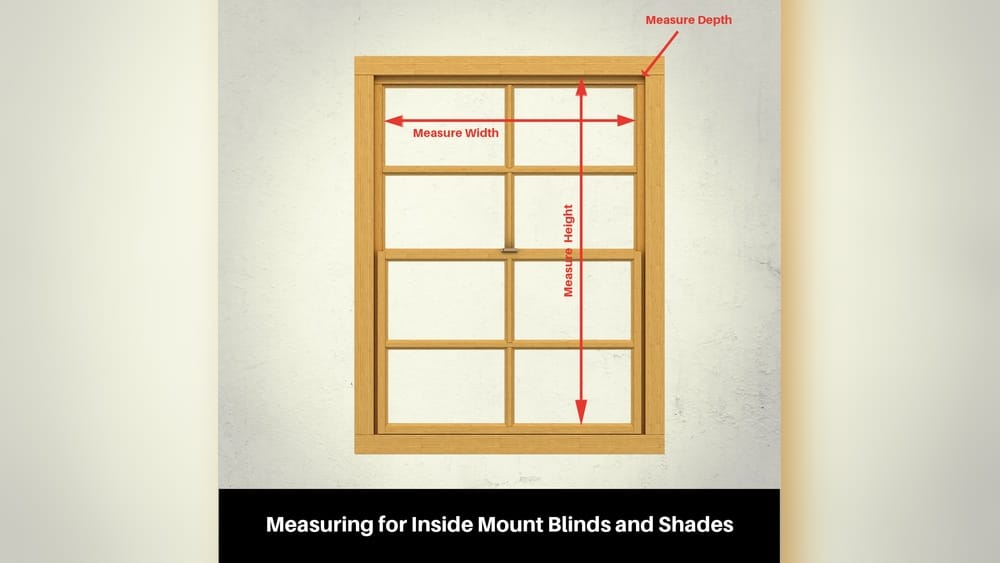
1. Measure The Window Width
- Use your tape to measure the width at three points: Top, middle, and bottom inside the window frame.
- Write down all three measurements.
- The narrowest width is your final width for ordering.
Why the narrowest? Window frames are rarely perfectly square. Blinds must fit the tightest part, or they won’t operate smoothly.
2. Measure The Window Height
- Measure the height at three points: Left, center, and right inside the frame.
- Record all three measurements.
- Use the longest height for your order.
Why the longest? This ensures your blind covers the entire opening, even if the frame isn’t perfectly straight.
3. Measure The Window Depth
- Place the tape against the glass and measure to the edge of the window frame.
- Check for obstructions like handles, tracks, or locks. Measure from the obstruction to the edge, not just glass to edge.
- Minimum depth is needed for the blinds to fit; check manufacturer requirements.
Pro tip: Most inside mount blinds need at least 1.5 inches of depth. Deeper windows allow more choices.
4. Double-check For Obstructions
- Look for window handles, cranks, alarm sensors, or window tracks.
- Take photos or note their locations.
- Measure how far these stick out into the window opening.
If obstructions are present, you may need a slimmer blind or consider an outside mount.
5. Record And Label Every Measurement
- Clearly write each measurement with the window location (e.g., “Living room left window – width: 34 1/8 in, height: 60 1/4 in, depth: 2 in”).
- Never round up or down. Exact numbers matter.
6. Repeat For Every Window
Even if windows look the same, measure each one. Tiny differences can cause big problems.

Credit: www.homedepot.com
Common Mistakes And How To Avoid Them
Even careful people make mistakes when measuring for inside mount blinds. Here are the most common issues and how to prevent them:
- Measuring the old blind, not the window opening.
- Only measure the window opening for inside mounts. Old blinds may be a different size.
- Using a cloth tape measure.
- Cloth tapes stretch and are not accurate enough. Always use a rigid steel tape.
- Rounding measurements.
- Don’t round up or down. Blinds need precise measurements, often to the nearest 1/8 inch.
- Not checking for obstructions.
- Handles, locks, sensors, and window cranks can block blinds from fitting or working.
- Measuring only once.
- Always measure width and height at three points to catch uneven frames.
- Ignoring minimum depth requirements.
- If your window is too shallow, the blinds may stick out or not fit at all.
- Forgetting to label measurements.
- Mixing up measurements between windows is a common cause of incorrect orders.
What To Do If Your Window Is Not Square
Many homes have windows that are a little wider at the top or bottom, or taller on one side. Here’s how to handle these cases:
- Width: Always use the narrowest width. This prevents blinds from being too wide to fit.
- Height: Use the tallest height. This ensures full coverage.
- Severe unevenness: If the difference is more than 1/2 inch between points, consider using an outside mount or getting custom blinds.
Practical example: If the top width is 35″, middle is 34 7/8″, and bottom is 34 1/2″, order for 34 1/2″.
Special Situations And How To Handle Them
Bay Windows
Bay windows have angled sides and need special attention. Measure each section as a separate window. Double-check the depth—sometimes the angles reduce usable space.
Windows With Tile Or Marble Sills
Measure from the surface of the tile or marble, not the window frame behind it. Some blinds may require spacers to fit correctly.
Windows With Tracks For Sliding Windows
Tracks often stick out and reduce usable depth. Measure from the most forward part of the track to the edge of the frame.
Window Grilles Or Mullions
If your window has fixed grilles or mullions, be sure your blind can fit between them. Some blinds, like cellular shades, are more flexible for tight spaces.
Key insight: If the window is very shallow or has many obstructions, consider a shallow depth blind or switch to an outside mount.
Comparing Inside Mount Vs Outside Mount Blinds
Sometimes, an inside mount isn’t the best option. Here’s a quick comparison to help you decide.
| Feature | Inside Mount | Outside Mount |
|---|---|---|
| Look | Built-in, clean | Bold, covers trim |
| Light Gap | Small gap at sides | Better coverage |
| Best For | Deep, even frames | Shallow, uneven frames |
| Obstructions | Needs clear opening | Can cover obstructions |
| Measuring Complexity | Requires precision | More forgiving |

Credit: gosmartblinds.com
Types Of Blinds And Their Depth Requirements
Each blind type has its own minimum depth. Not all inside mounts will fit all blinds. Here’s a comparison of popular options:
| Blind Type | Minimum Depth (inches) | Best For |
|---|---|---|
| Mini Blinds | 1 to 1.5 | Shallow frames, low cost |
| Wood/Faux Wood | 2 to 3 | Classic style, privacy |
| Cellular Shades | 1 to 2 | Energy savings, tight spaces |
| Roller Shades | 1.25 to 2.5 | Sleek look, easy cleaning |
| Vertical Blinds | 2.5 to 3 | Large windows, sliding doors |
Tip: Always check the manufacturer’s specs before ordering. Some custom blinds can work with less depth, but may have exposed hardware.
How To Measure For Different Blind Styles
While the basic steps are the same, there are small differences between blind types.
Venetian And Mini Blinds
- Use the narrowest width and longest height.
- Allow a little extra depth for the headrail.
Cellular Shades
- These are forgiving for uneven frames.
- Some models require less depth.
Roller Shades
- The fabric will be a little narrower than the headrail.
- Be careful with very narrow windows, as light gaps may be visible.
Roman Shades
- Require a deeper frame for a smooth stack.
- Good for decorative windows.
Vertical Blinds
- Usually for wide or sliding windows.
- Measure width at the top only, as the headrail mounts there.
- Use the shortest height if the floor is uneven.
Ordering Your Blinds: Exact Vs Deducted Measurements
Most blind companies ask for either the exact size you want the blind to be or the window opening measurement. For inside mounts, always provide the window opening size, not your desired blind size.
Manufacturers will make a small deduction (usually 1/4 to 1/2 inch) from the width so the blind fits inside the opening. This is called a “factory deduction. ” You do not need to subtract this yourself—just give the exact window opening measurements.
Practical example: If your window opening is 36″ wide, order 36″. The company will adjust as needed.
What To Do Before Placing Your Order
Before you order, review each window:
- Check that each measurement is clearly labeled and matches the window location.
- Confirm the minimum depth is met for your chosen blind type.
- Double-check for obstructions.
- Take photos of tricky windows for reference.
If in doubt, call the blind company’s customer service. Most will help check your measurements before you order.

Credit: gosmartblinds.com
How To Handle Complicated Windows
Some windows don’t fit the mold. Here’s how to handle:
Arched Windows
- Measure the width at the base.
- Measure height at the center.
- Some blinds are made for the lower rectangle only, leaving the arch open.
Corner Windows
- Measure both windows as separate openings.
- Consider clearance if both will have blinds that might hit each other.
Very Large Windows
- Some wide windows may need two blinds side by side.
- Leave a small gap (about 1/4 inch) between them for smooth operation.
Real-world Example: Measuring A Living Room Window
Let’s walk through a real measurement:
- Window opening at top: 35 3/8″
- Window opening at middle: 35 1/4″
- Window opening at bottom: 35″
- Height at left: 60 1/2″
- Height at center: 60 5/8″
- Height at right: 60 3/4″
- Depth (to window handle): 2″
Result: Order width = 35″, height = 60 3/4″, depth = 2″. Blinds must fit at least 2″ depth.
Extra Tips For Flawless Results
- Measure twice, order once. Double-check before submitting.
- Don’t mix up inside and outside mount instructions. They are not the same.
- Label every window and measurement. Prevents confusion if ordering for multiple rooms.
- Take a photo of each window and its measurements. Helps with future repairs or replacements.
- Order sample blinds or swatches. Ensures you like the look and material before buying.
When To Call A Professional
If you have:
- Irregular window shapes (arched, angled, or round)
- Heavy obstructions (security bars, deep handles)
- Historic or antique windows
- Very expensive or custom blinds
Consider hiring a professional. They have tools and experience to ensure a perfect fit. Many blind companies offer free or low-cost measurement services.
The Cost Of Measurement Mistakes
Ordering the wrong size blinds is more common than you might think. According to industry data, nearly 20% of custom blind orders are returned or replaced due to measurement errors. This can cost you extra shipping, restocking fees, or even require buying new blinds.
A few careful minutes measuring can save you hundreds of dollars.
Key insight: Always read your blind supplier’s return policy. Some custom blinds are non-returnable if you measure wrong.
How To Communicate Your Measurements
When you order, give:
- Window location (e.g., “kitchen left”)
- Inside mount (not outside)
- Width x height x depth, in inches, to the nearest 1/8 inch
Example: “Bedroom window, inside mount, 34 1/2” W x 60 3/4” H x 2” D”
Most online order forms let you enter these details. If unsure, call to confirm.
Caring For Your Window Frame During Measurement
Be gentle with old or painted frames. Press the tape measure lightly to avoid scratching or damaging the finish. If the frame is warped or soft, note it—this can affect blind operation.
Tip: If your frame is uneven due to age or settling, inside mount blinds may not work well. Consider outside mount or consult a pro.
How To Handle Light Gaps
All inside mount blinds have a small light gap at the edges. This is necessary for the blind to move up and down. If you need total blackout, consider an outside mount, or use curtains along with your blinds.
Measuring For Motorized Or Smart Blinds
Motorized blinds often need a bit more space for wiring or battery packs. Always check the manufacturer’s depth requirements. Take photos of your window and send to the supplier if needed.
Sample Measurement Worksheet
Here’s a simple worksheet you can use for each window:
| Window Location | Top Width (in) | Middle Width (in) | Bottom Width (in) | Narrowest Width (in) | Left Height (in) | Center Height (in) | Right Height (in) | Longest Height (in) | Depth (in) | Obstructions? |
|---|---|---|---|---|---|---|---|---|---|---|
| Bedroom | 36 | 35 7/8 | 35 3/4 | 35 3/4 | 58 1/2 | 58 5/8 | 58 3/4 | 58 3/4 | 2.5 | No |
Where To Find More Guidance
Most major blind suppliers offer free online guides and videos. The Blinds.com website has a useful resource for beginners. For official instructions and more details, check out Hunter Douglas.
Frequently Asked Questions
How Much Smaller Do Inside Mount Blinds Need To Be Than The Window Opening?
You do not need to subtract anything from your measurements. The blind manufacturer will automatically make a small deduction (usually 1/4″ to 1/2″ in width) so the blind fits inside the window. Just provide the exact window opening size.
Can I Use The Same Measurement For All Windows In A Room?
No. Even if windows look identical, measure each one. Homes settle over time, and frames can shift. Always measure each window separately for the best fit.
What If My Window Is Too Shallow For Inside Mount Blinds?
If your window depth is less than the blind’s minimum requirement, you have two options: choose a different blind with a lower minimum depth, or use an outside mount blind, which does not need as much depth.
Do I Need Special Tools To Measure For Blinds?
No. All you need is a steel tape measure, a pencil, and paper. A level and smartphone are helpful but not required. Avoid using cloth tapes for this task.
Will Inside Mount Blinds Provide Complete Blackout?
No inside mount blind is 100% blackout due to the small light gaps needed for movement. For full blackout, consider an outside mount blind or pair your blinds with blackout curtains.
Measuring windows for inside mount blinds is a straightforward process if you take your time and follow each step closely. Clear, accurate measurements will ensure your new blinds fit perfectly and look great. Don’t rush, double-check every number, and don’t be afraid to ask for help if you have an unusual window.
The result will be a more comfortable, stylish, and private home.